AV logistics for multi-venue events: the UK planner’s guide
Date added: 8/07/2026

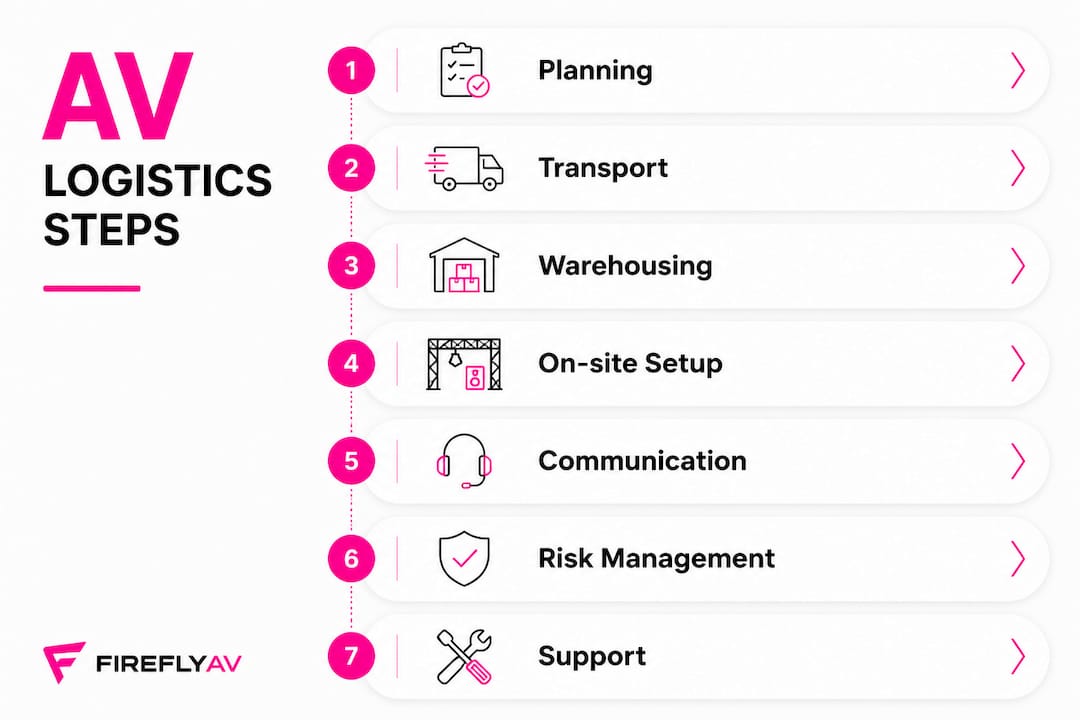
Managing AV logistics across multiple venues is one of the most operationally demanding challenges in UK event production. Unlike single-venue work, multi-venue AV logistics requires coordinating transport routing, equipment warehousing, dock scheduling, crew deployment, and technical setup across several locations simultaneously. Miss one dependency and the knock-on effect travels fast. The core discipline here covers:
- Transport scheduling: routing vehicles across venues with staggered load-in windows
- Equipment warehousing and pre-staging: inventory audits, packing, labelling, and protection of sensitive gear
- Dock management: per-venue capacity planning to prevent arrival conflicts
- Cross-venue freight coordination: priority-aware sequencing so the right kit arrives first
- Personnel coordination: crew allocation, travel scheduling, and on-site supervision
- Customs compliance: ATA Carnets and UK-EU border documentation for touring productions
- Technical synchronisation: ensuring consistent AV standards across all sites
The ANSI/AVIXA D401.01:2023 standard provides the recognised framework for documenting and coordinating AV system design and installation across multi-site projects. Fireflyav draws on this standard and its own depth of experience in corporate conferences, live events, and broadcast production to support planners navigating exactly this complexity.
Table of Contents
- What does AV logistics management actually involve across multiple venues?
- How do you schedule and communicate across multiple venues without losing control?
- What risks should you plan for in multi-venue AV logistics?
- How do you choose the right AV logistics partner for multi-venue events?
- Power supply and backup solutions for simultaneous venue operations
- Fireflyav: AV equipment and technical support for multi-venue events
- Key takeaways
What does AV logistics management actually involve across multiple venues?
Multi-venue AV logistics requires centralised control of complex transportation, warehousing, and synchronised site builds in a way that single-venue production simply does not. Every hand-off needs logging, every location needs confirming, and every conflict needs catching before a truck rolls.
Transport management and routing
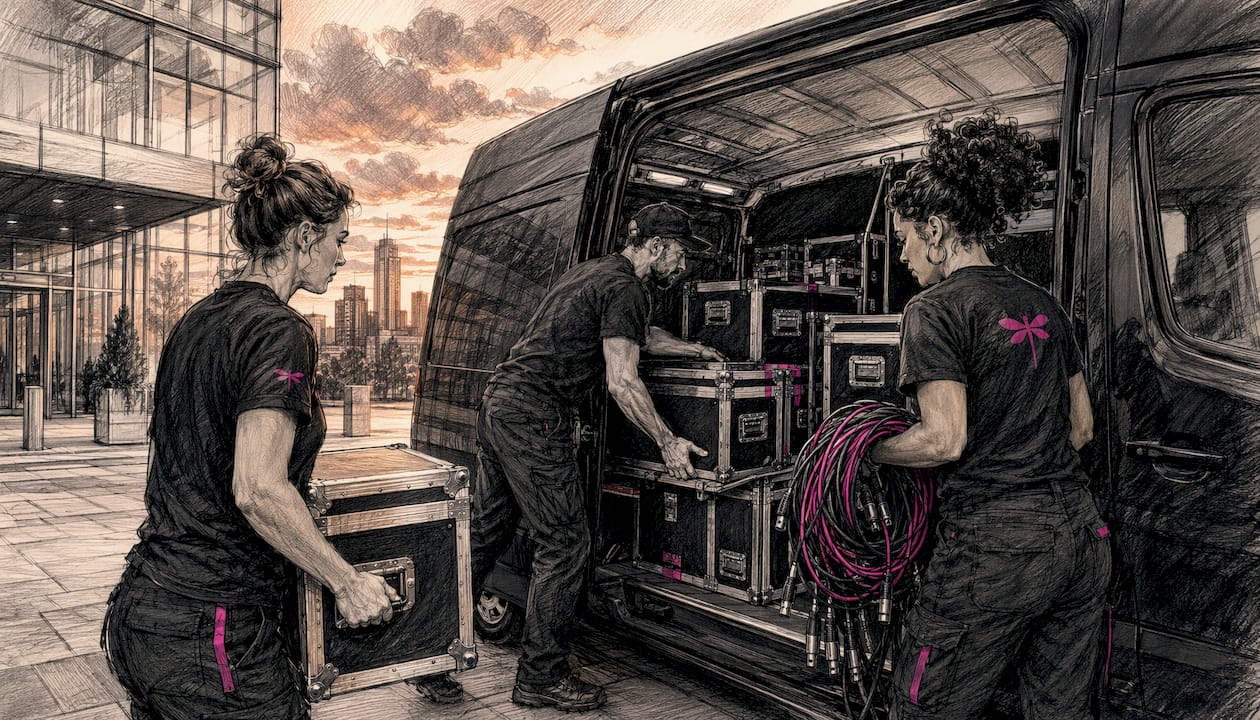
Vehicle selection matters more than planners often expect. A van that works for a single corporate conference becomes a liability when you need split deliveries across three venues on the same morning. Assign vehicles based on equipment volume, weight, and fragility, then build routes that account for realistic unloading times at each dock. Stagger delivery windows deliberately: two trucks arriving at the same loading bay simultaneously is one of the most common causes of on-day delays.
Equipment warehousing and pre-staging
Detailed inventory audits before any kit leaves the warehouse prevent the worst surprises. Every item should be checked against a manifest, packed with appropriate protection, and labelled clearly with its destination venue and unloading order. Treat the Bill of Materials as a live freight manifest per venue, not a static spreadsheet. Experienced logistics teams use this document to hunt for dock and delivery conflicts before deployment begins.
Pro Tip: Use asset lifecycle tracking software to maintain a scan-in/scan-out record for every piece of kit from warehouse to venue. Chain of custody loss across multiple sites leads directly to cost overruns and delays.
On-site operational logistics
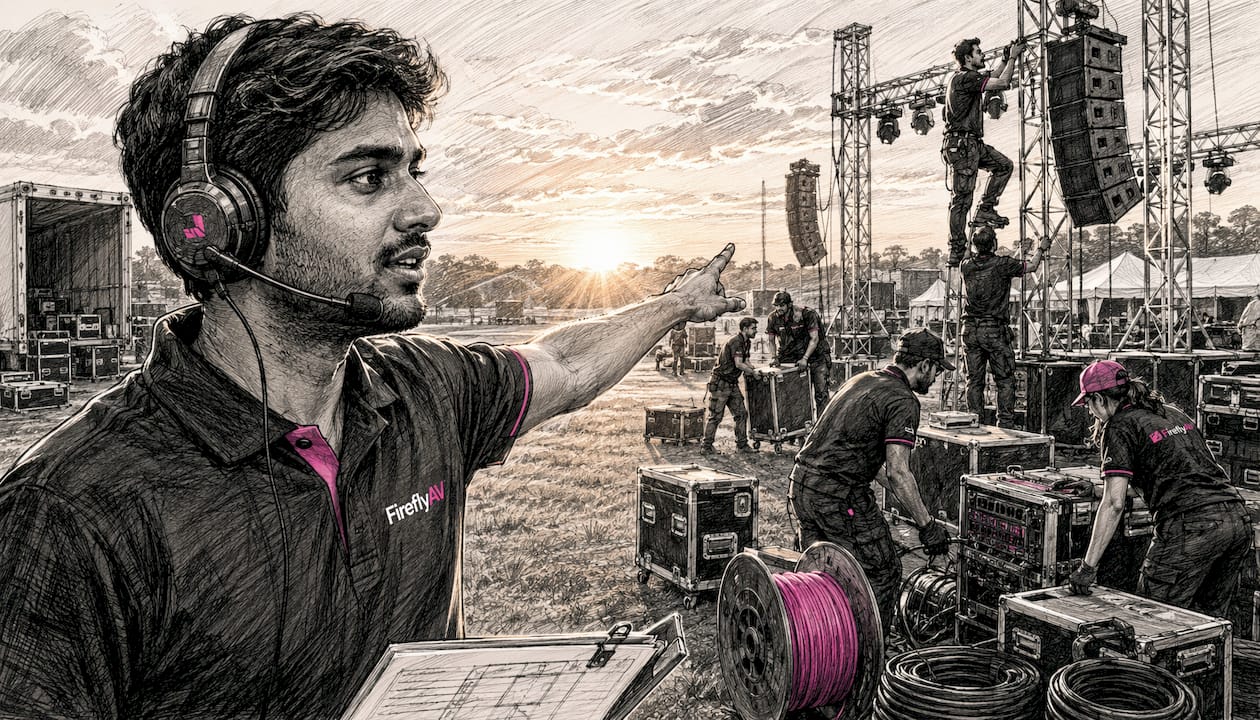
Venue etiquette varies considerably across UK sites. Some venues impose strict load-in windows, restrict rigging to approved contractors, or limit electrical draw per circuit. Briefing your crew on venue-specific rules before arrival avoids costly rework. On-site supervision by a crew lead at each location keeps technical standards consistent and gives you a single point of escalation when something needs resolving quickly.
| Logistics task | Responsible role |
|---|---|
| Inventory audit and manifest creation | Warehouse manager |
| Vehicle routing and dock scheduling | Logistics coordinator |
| Equipment packing and labelling | Warehouse crew |
| On-site setup and rigging | Technical crew lead |
| Cross-venue freight sequencing | Production manager |
| Asset tracking and chain of custody | Logistics coordinator |
| Crew scheduling and travel | Production manager |
A useful real-world illustration: a corporate conference series running across four UK cities on consecutive days requires the same AV rig to be broken down, transported overnight, and rebuilt to the same specification each morning. The only way that works without a technical failure is a pre-agreed manifest, a tested packing sequence, and a crew lead at each venue who knows the spec without needing to be briefed from scratch.
How do you schedule and communicate across multiple venues without losing control?
Scheduling for multi-venue events works backwards from showtime, not forwards from load-in. For each venue, establish when doors open, then calculate backwards through rehearsal, testing, rigging, and load-in to set a realistic truck arrival time. When you have four venues running in parallel, those windows need staggering carefully: the same driver cannot be in two places, and not every loading bay is straightforward.
Digital tools like OnePlan and Envitely enable real-time collaborative scheduling and equipment tracking across venues, giving all stakeholders a single source of truth rather than a tangle of spreadsheets and email chains. Centralising scheduling and asset tracking in one platform reduces errors and keeps updates visible to everyone who needs them.
Effective communication tools and methods for multi-venue coordination include:
- Centralised project management platform (OnePlan, Envitely, or equivalent) for live schedule updates
- Radio or push-to-talk apps for on-site crew at each venue
- Shared digital manifests accessible to warehouse, transport, and venue teams
- WhatsApp or messaging groups segmented by venue, not by function, to keep information local
- Pre-event briefing documents per venue covering access times, dock details, and venue contacts
- Escalation protocols defining who calls whom when something goes wrong
The single-filter communication approach is worth adopting on any event with more than two venues. One project manager collects questions and updates from all site leads, then presents them to the client in a single consolidated call or message. Three separate planners pinging the same client simultaneously creates confusion and erodes trust.
Pro Tip: Multi-venue logistics partners must be reachable beyond standard hours. Builds do not happen 9 to 5, and a crew change at 11 PM needs a logistics contact who picks up.
What risks should you plan for in multi-venue AV logistics?
The most common failure points in multi-venue AV logistics are dock-window collisions, misrouted gear, chain of custody loss, and venue-specific restrictions that were not identified during planning. Each of these is preventable with the right preparation.
Dock conflicts are particularly damaging because they create a cascade: one delayed truck pushes back load-in, which compresses rehearsal time, which means the show starts late or with untested equipment. A logistics system that scans for dock overlaps before trucks depart catches these conflicts at the point when they are still cheap to fix.
Key risk management tactics:
- Pre-event dock conflict scan: check all truck arrivals against venue dock capacity and turn-around windows before the morning of the event
- Clear labelling and manifests: every case labelled with venue, room, and unloading sequence
- On-site supervision: a crew lead at each venue with authority to make real-time decisions
- Contingency reserves: spare cables, adaptors, and consumables packed per venue
- Pre-event equipment audit: test all kit before it leaves the warehouse, not on arrival
- AV event insurance: cover for equipment damage, theft, or failure during transit and on-site
- Customs documentation: ATA Carnets for any equipment crossing UK-EU borders, with copies held by both the driver and the production office
Chain of custody loss across multiple venues is one of the leading causes of cost overruns in large-scale event production. Scan-in/scan-out systems and clear manifests are the practical fix.
For UK-EU touring productions, customs compliance adds a layer that purely domestic events avoid. ATA Carnets allow temporary export of professional equipment without paying import duties, but they require advance preparation and accurate equipment lists. Getting this wrong at the border can hold up an entire truck.
How do you choose the right AV logistics partner for multi-venue events?
The right logistics partner for multi-venue AV work is not simply a haulage company that handles events. You need a partner who understands the event environment: the difference between a loading bay shared with catering and camera crews, the reality of a 4 AM warehouse departure, and the pressure of a show that cannot be delayed.
Criteria for selecting a partner:
- Demonstrable UK multi-venue experience, not just single-site haulage
- Real-time vehicle tracking accessible to your production team
- 24/7 availability with named contacts, not a general helpline
- Familiarity with AV equipment handling, including fragile and high-value items
- Understanding of venue-specific access restrictions and dock protocols
- Ability to hold and stage kit between event legs, not just deliver and collect
- Clear escalation process for last-minute changes
Steps to establish a productive working relationship:
- Share the full event schedule, including all venue addresses, dock details, and load-in windows, at the earliest opportunity
- Agree a single point of contact on both sides for all logistics decisions
- Define in writing who has authority to approve last-minute route or schedule changes
- Conduct a pre-event briefing covering all venues, dependencies, and contingency plans
- Agree a communication protocol for out-of-hours contact
Pro Tip: Consolidate all logistics communication through one project manager on your side. When multiple site leads report independently to the client, information overload follows quickly.
Questions to ask when vetting a logistics partner:
- Can you show examples of multi-venue UK events you have managed?
- How do you handle a dock conflict discovered on the morning of the event?
- What is your process when a vehicle breaks down en route?
- How do you track equipment across multiple venues simultaneously?
- Who is my named contact outside business hours?
Understanding why corporate events rely on specialist AV coordination helps frame what you should be asking of any logistics partner you bring on board.
Power supply and backup solutions for simultaneous venue operations
Power planning for multi-venue events deserves its own conversation because the risks compound when several venues are running simultaneously. A power failure at one site during a live broadcast or conference session cannot be resolved by pulling resource from another location.
Each venue needs its own power assessment before any equipment is specified. UK venues vary considerably in their available supply: an older city-centre hotel may have limited three-phase capacity, while a purpose-built conference centre will handle large draws without issue. Identify the peak load for each venue’s AV rig, including lighting, sound, video, and any broadcast equipment, then confirm the venue can supply it with headroom to spare.
Backup solutions worth building into every multi-venue plan:
- Uninterruptible power supplies (UPS) for critical signal processing and switching equipment at each venue
- Generator hire as a standby option for venues with unreliable mains supply or outdoor locations
- Separate circuit allocation for AV and lighting to prevent a lighting fault tripping the sound system
- Spare power distribution units packed per venue in the contingency reserve
- Parts and inventory management systems to track power accessories across the full event footprint
The practical rule is to treat power as a logistics dependency, not an afterthought. If a venue’s power supply cannot be confirmed until load-in day, that is a risk that belongs on your pre-event risk register, not a surprise to manage on the day.
Fireflyav: AV equipment and technical support for multi-venue events
Fireflyav supplies AV equipment and technical support for corporate conferences, live events, broadcast productions, and eSports across the UK. For planners managing multi-venue productions, Fireflyav offers the combination that matters most: a deep equipment inventory and experienced technical staff who understand the operational realities of multi-site delivery.
Where a general hire company hands over kit and leaves, Fireflyav provides technical support through the full production cycle, from pre-event specification and equipment testing to on-site operation and breakdown. That means fewer unknowns when you are coordinating across several venues at once. The AV equipment range covers everything from conference microphone systems and video switching to broadcast-grade display and audio solutions.
If you are planning a multi-venue conference, corporate event series, or live production in the UK, submit your project details and the Fireflyav team will come back with equipment recommendations and technical support options matched to your specific venues and schedule.
Key takeaways
Effective AV logistics for multi-venue events depends on centralised coordination of transport, equipment tracking, power planning, and communication, with a single project manager holding the threads together across all sites.
| Point | Details |
|---|---|
| Centralise scheduling and tracking | Use one platform for all venue schedules and asset tracking to prevent conflicts and errors. |
| Treat the Bill of Materials as a live manifest | Update the freight manifest per venue continuously and use it to hunt dock conflicts before deployment. |
| Apply the single-filter communication rule | One project manager synthesises updates from all site leads and presents them to the client as one. |
| Plan power per venue independently | Assess peak load and backup requirements at each site; never assume uniform supply across venues. |
| Fireflyav for UK multi-venue production | Fireflyav supplies equipment and on-site technical support for corporate, broadcast, and live event productions across the UK. |