MADI audio explained: the professional’s complete guide
Date added: 9/07/2026

MADI, short for Multichannel Audio Digital Interface, is a standardised protocol for transmitting up to 64 channels of uncompressed digital audio over a single coaxial or fibre optic cable. Defined by the AES10 standard from the Audio Engineering Society, it was first published in 1991 and has since become a cornerstone of professional audio infrastructure worldwide. At 44.1 kHz or 48 kHz, you get the full 64 channels. Push the sample rate to 96 kHz and that count drops to 32, a trade-off baked into the specification.
What sets MADI apart from most digital audio protocols is its unidirectional, point-to-point nature. There is no network to configure, no IP addressing, and no routing software to manage. You connect a transmitter to a receiver, and audio flows. That simplicity is precisely why broadcast engineers, live sound professionals, and studio operators have relied on it for decades. Latency is deterministic and extremely low, which matters enormously when you are running 64 channels of live audio to a mixing console with zero tolerance for glitches.
- Carries up to 64 uncompressed audio channels over a single cable
- Governed by the AES10 standard (Audio Engineering Society)
- Supports sample rates from 32 kHz up to 96 kHz and beyond
- Channel count reduces to 32 at 96 kHz
- Unidirectional, point-to-point: one transmitter, one receiver
- No network configuration required once the physical connection is made
- Used extensively in live sound, broadcast, and recording studio environments
- Replaces bulky analogue multicore snakes with a single lightweight cable
What is MADI audio explained: technical features and specifications
MADI transmits audio at a base data rate of 100 Mbit/s, using 4B5B encoding to produce a physical baud rate of 125 MHz. That encoding scheme replaces every 4 source bits with a unique 5-bit sequence, ensuring the signal never carries long runs of identical bits that would cause synchronisation problems. The result is a clean, reliable bitstream that travels over coaxial or fibre optic cable without the noise vulnerabilities of analogue transmission.
Each channel in the MADI frame carries 32 bits, of which 24 are allocated to audio data. The remaining bits handle validity, user data, status, parity, and mode identification, preserving compatibility with the AES3 two-channel format at the sub-channel level. Frame synchronisation is provided by sync symbols outside the audio data itself, rather than embedded preambles, which keeps the audio payload clean and consistent.
| Sample rate | Maximum channels | Bit depth |
|---|---|---|
| 32 kHz | 64 | Up to 24 bits |
| 44.1 kHz | 64 | Up to 24 bits |
| 48 kHz | 64 | Up to 24 bits |
| 96 kHz | 32 | Up to 24 bits |
Clocking is where MADI demands attention. The transmission clock is deliberately decoupled from the audio sample rate, which means all devices in a MADI chain must share a common word clock source to maintain sample accuracy. Without proper word clock synchronisation, you will hear clicks, pops, and timing drift. Some hardware vendors offer the option to derive a word clock from the MADI transmission timing itself, but an external word clock distribution system remains the professional standard.
Key technical characteristics worth knowing:
- 4B5B encoding converts 100 Mbit/s data to a 125 MHz physical signal
- NRZI transmission (Non-Return to Zero, Invert on Ones) maintains a low DC bias on the link
- Frame structure supports 56 or 64 sub-channels per frame
- Word clock must be distributed externally for sample-accurate synchronisation
- Unidirectional streams mean full-duplex operation requires two separate MADI streams
- AES3 compatibility is preserved at the sub-channel data level
Pro Tip: If you are building a MADI system from scratch, invest in a dedicated word clock distribution unit before anything else. Chasing synchronisation problems after the fact on a live rig is a miserable experience.
What cables and connectors does MADI use?
MADI runs over two physical media: 75-ohm coaxial cable with BNC connectors, and optical fibre with SC connectors. The AES10-2003 revision formally recommends both connector types, and the choice between them usually comes down to distance and environment.
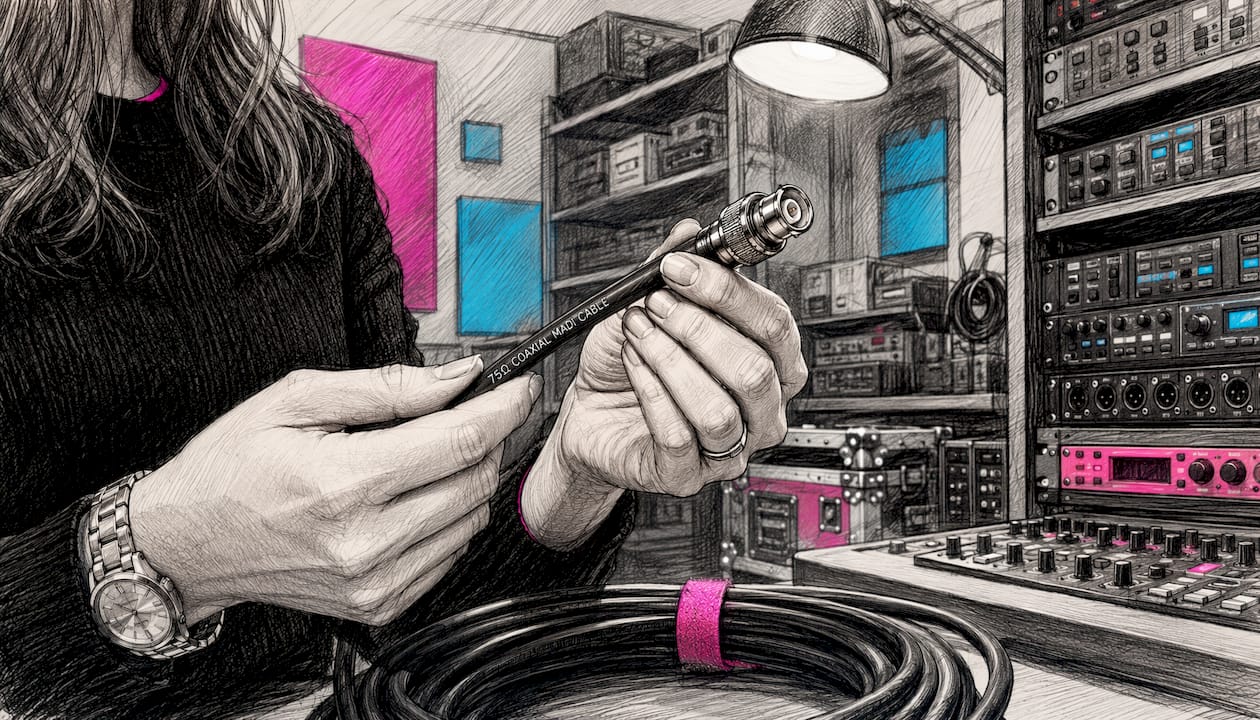
Coaxial cable handles runs of up to 100 metres, which covers most stage-to-FOH or rack-to-console distances in a typical venue. It is affordable, widely available, and straightforward to terminate. The 75-ohm impedance is the same as standard video coax, so in a pinch you can use broadcast-grade video cable, though dedicated MADI coax is always preferable for critical applications.
Optical fibre extends that reach dramatically, supporting distances of up to 2 kilometres depending on the cable type and quality. For live touring, broadcast trucks parked outside a venue, or inter-building connections in a broadcast facility, fibre is the obvious choice. It also eliminates electromagnetic interference entirely, which matters in environments packed with RF transmitters, LED walls, and motor drives.
- 75-ohm BNC coaxial: up to 100m, cost-effective, easy to terminate on-site
- Optical fibre (SC connectors): up to 2km, immune to EMI, preferred for long runs
- Multimode OM3/OM4 fibre: well-suited for live environments up to around 500m, valued for durability
- Cable weight: a single MADI cable replaces a 64-channel analogue multicore, saving considerable weight and bulk on touring rigs
- Fault finding: a single cable failure is far easier to diagnose than a fault buried in a 64-way analogue snake
Statistic callout: A single MADI coaxial cable replaces what would otherwise be a 64-channel analogue multicore snake, reducing cabling weight and cost while simplifying fault-finding across the entire signal chain.
Pro Tip: For outdoor festival rigs or broadcast trucks, always choose fibre over coax. The EMI rejection alone is worth it, and the weight saving on a long stage-to-truck run is genuinely significant.
How MADI is used in professional audio environments
MADI’s most common application is linking a digital mixing console to a stage box or I/O rack. A single cable carries all 64 channels of microphone and line inputs from the stage to the front-of-house position, with a second cable returning monitor feeds, effects, and outputs back to the stage. That two-cable solution replaces what used to be a heavy, expensive analogue multicore. For a large touring production, the difference in truck space and load-in time is measurable.
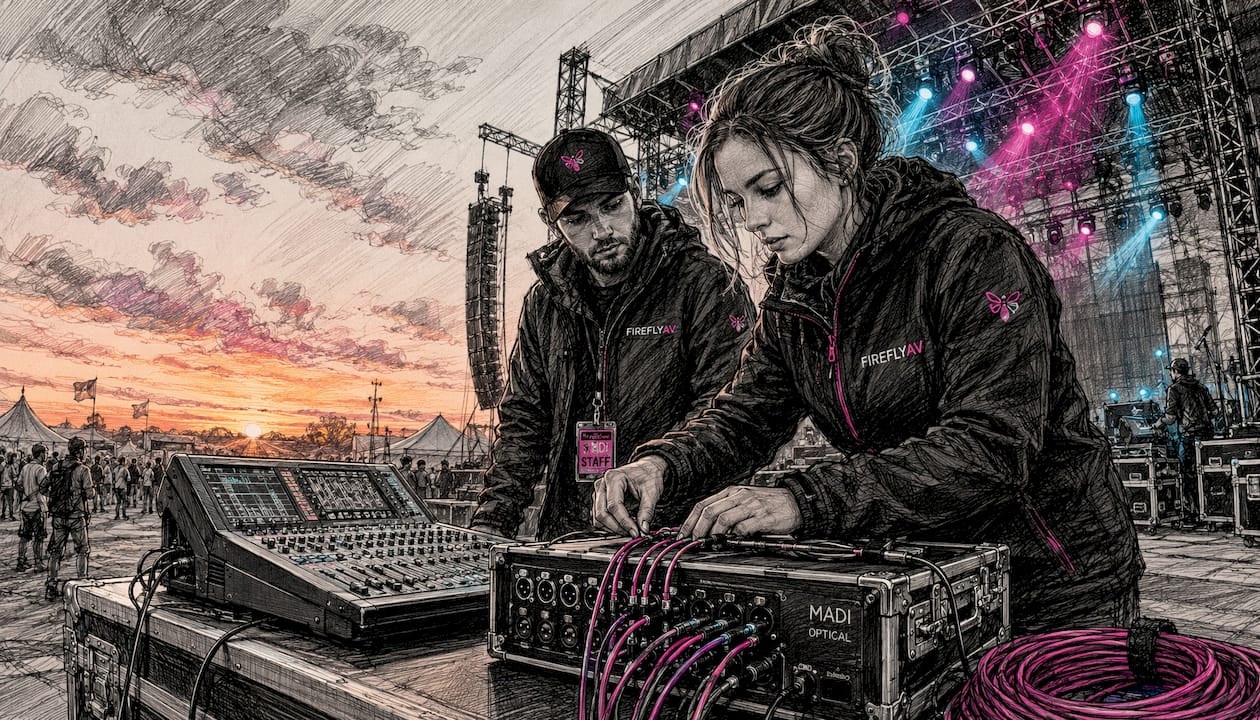
Broadcast is where MADI truly proved its worth. Large broadcast studios adopted the protocol early for routing multichannel audio throughout their facilities, and it remains standard in outside broadcast trucks and production galleries across the UK. The ITU-R BS.1873 recommendation formally specifies MADI as the serial multichannel audio digital interface for broadcasting studios, which tells you everything about its status in that world.
Common professional applications include:
- Linking digital mixing consoles (such as the Allen & Heath Avantis) to stage I/O boxes
- Connecting multitrack recorders to mixing systems for live recording
- Routing audio between production galleries and studio floors in broadcast facilities
- Interfacing outside broadcast trucks with venue audio infrastructure
- Distributing audio across large venues with multiple mix positions
- Connecting recording studio patchbays to DAW interfaces and outboard racks
The reliability argument is straightforward. MADI carries no network overhead, has no routing tables to corrupt, and does not depend on a switch or server staying online. When a live broadcast goes out to millions of viewers, that predictability is not a luxury.
How does MADI compare with Dante and other network audio protocols?
MADI and Dante solve the same fundamental problem, moving many channels of audio from one place to another, but they approach it very differently. MADI is a dedicated point-to-point connection with no network overhead. Dante is Audio over IP, running on standard Ethernet infrastructure, with flexible routing, bi-directional channels, and centralised network management.
The practical difference shows up under pressure. MADI’s latency is fixed and deterministic because there is no network stack involved. Dante’s latency is configurable and generally very low, but it depends on network quality, switch configuration, and QoS settings. In a well-managed network, Dante performs brilliantly. In a venue with a shared or poorly configured network, it can be a source of problems.
MADI strengths:
- Zero network configuration once the cable is connected
- Deterministic, hardware-level latency
- No dependency on switches, routers, or network services
- Sample-accurate timing for phase-coherent multichannel audio
- Preferred by engineers where failure is genuinely not an option
MADI limitations:
- Unidirectional: full-duplex requires two separate cable runs
- Fixed point-to-point topology: no multi-drop or broadcast routing
- Manual word clock synchronisation required
- Channel count is capped at 64 (or 32 at 96 kHz)
Dante strengths:
- Bi-directional on a single Ethernet cable
- Flexible routing between multiple devices on the same network
- Scalable to hundreds of channels across a facility
- Centralised management via software
Dante limitations:
- Requires a properly configured network infrastructure
- Latency depends on network quality and switch capability
- More complex to troubleshoot when problems occur
For a fixed broadcast installation with a well-managed network, Dante’s flexibility is genuinely useful. For a touring rig or a one-off live event where you need absolute certainty that audio will flow the moment you plug in the cable, MADI remains the professional’s choice.
How the MADI signal format and data transmission actually work
The MADI signal format builds directly on the AES3 two-channel interface, extending it to carry up to 64 channels in a single serial stream. Each frame consists of up to 64 sub-channels, numbered 0 to 63, transmitted sequentially within a single sample period. Every sub-channel carries 32 bits: 24 bits of audio data, 4 bits of AES3 status information (validity, user, status, parity), and 4 mode bits that handle frame synchronisation, block start identification, and active or inactive channel status.
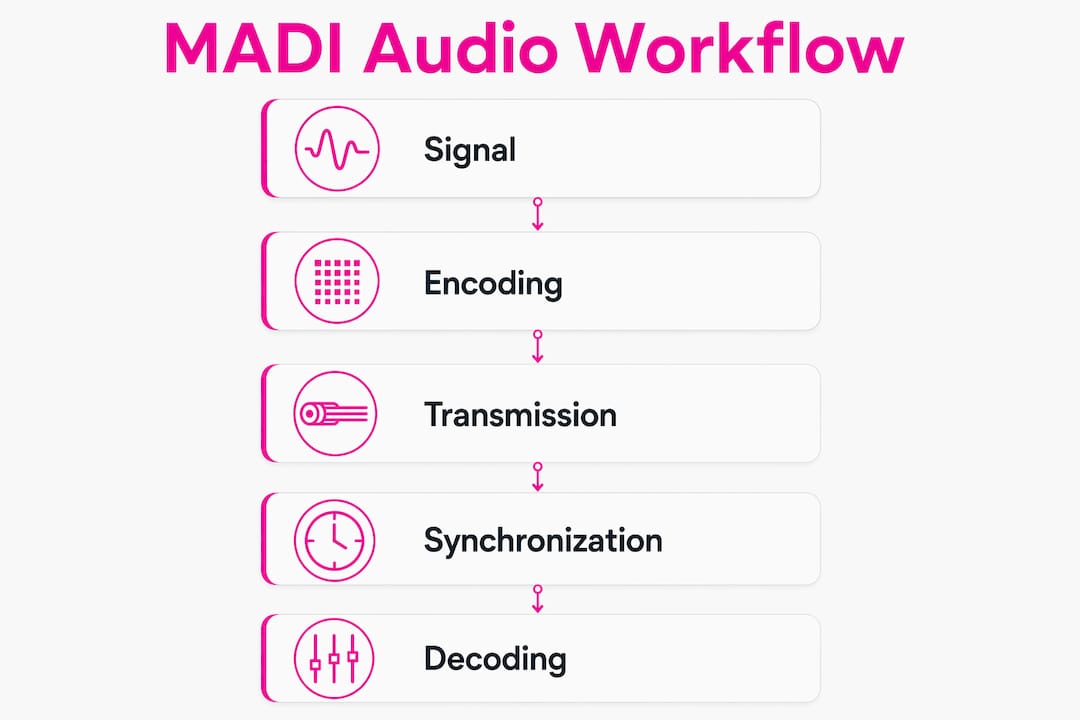
The 4B5B encoding scheme is central to how MADI achieves reliable transmission at 100 Mbit/s. Every group of 4 data bits is replaced by a 5-bit code word chosen to avoid long sequences of identical bits. This keeps the signal AC-coupled and prevents the receiver from losing synchronisation. The encoded stream is then transmitted using NRZI (Non-Return to Zero, Invert on Ones), where a logical 1 is represented by a polarity transition and a logical 0 by the absence of one. The combination keeps DC bias low and makes the signal polarity-independent on the cable.
Frame synchronisation uses JK sync symbols inserted outside the audio data payload. These symbols can appear at any sub-channel boundary and must occur at least once per frame. Because the transmission clock runs independently of the audio sample rate, the sync symbols also serve as padding to fill the fixed-rate bitstream when the audio data does not occupy the full frame. This is why external word clock is not optional: the protocol itself does not carry enough timing information to reconstruct the audio sample rate at the receiver without it.
Active channels are always consecutive, starting at channel zero. The active channel bit within each sub-channel tells the receiver whether that slot carries live audio or is inactive. This means a 32-channel MADI system and a 64-channel system use exactly the same physical link; the receiver simply reads the active channel flags to know how many channels to process.
How Fireflyav uses MADI in UK professional audio setups
Fireflyav supplies MADI-enabled equipment and technical support across the UK’s corporate, cultural, broadcast, and live event sectors. For large-scale productions, whether a touring concert, a broadcast outside broadcast, or a major corporate conference, MADI is frequently the backbone of the audio infrastructure. The protocol’s combination of high channel count, low latency, and zero network dependency makes it well-suited to the demanding environments Fireflyav regularly works in.
UK venues present specific challenges: long cable runs between stages and control positions, listed buildings where cable routing is constrained, and broadcast integrations where timing and reliability are non-negotiable. MADI’s fibre optic option addresses the distance problem cleanly, while its deterministic behaviour suits broadcast-grade requirements. Fireflyav’s team advises clients on the right MADI configuration for each venue, from connector choice to word clock distribution strategy.
Fireflyav’s equipment range includes gear that integrates directly with MADI workflows:
- Digital mixing consoles with native MADI I/O for live and broadcast applications
- Stage boxes and I/O racks that connect via MADI to front-of-house positions
- DI boxes such as the Radial Pro-AV1 for signal interfacing within MADI-connected systems
- Audio players and playback systems that feed into MADI-enabled rigs
- Word clock distribution and synchronisation equipment for multi-device MADI setups
For event planners and producers working with Fireflyav, understanding MADI is part of understanding why a single cable can replace an entire analogue infrastructure. The AV equipment guide on the Fireflyav website covers the broader context of how MADI fits within a complete audio visual system. Whether you are specifying a broadcast truck integration or a touring festival rig, Fireflyav’s technical team can advise on MADI system design, equipment selection, and on-site setup.
For producers interested in how modern audio analysis tools complement MADI-based production workflows, the AI mix analysis guide from Mix Analyzer Blog offers useful context on where technology is heading in professional audio production.
Key takeaways
MADI (AES10) transmits up to 64 uncompressed audio channels over a single cable with deterministic low latency, making it the preferred protocol for live, broadcast, and studio environments where reliability is non-negotiable.
| Point | Details |
|---|---|
| Channel capacity | MADI carries up to 64 channels at 48 kHz, reducing to 32 channels at 96 kHz. |
| Cable options | Coaxial BNC runs up to 100m; optical fibre extends to 2km with full EMI immunity. |
| Word clock requirement | All MADI devices must share an external word clock source to maintain sample-accurate timing. |
| Protocol nature | MADI is unidirectional and point-to-point; full-duplex operation requires two separate cable runs. |
| UK professional use | Fireflyav deploys MADI across UK live events, broadcast, and corporate productions for its reliability and simplicity. |