Why redundancy matters for live events: a UK guide
Date added: 9/08/2026
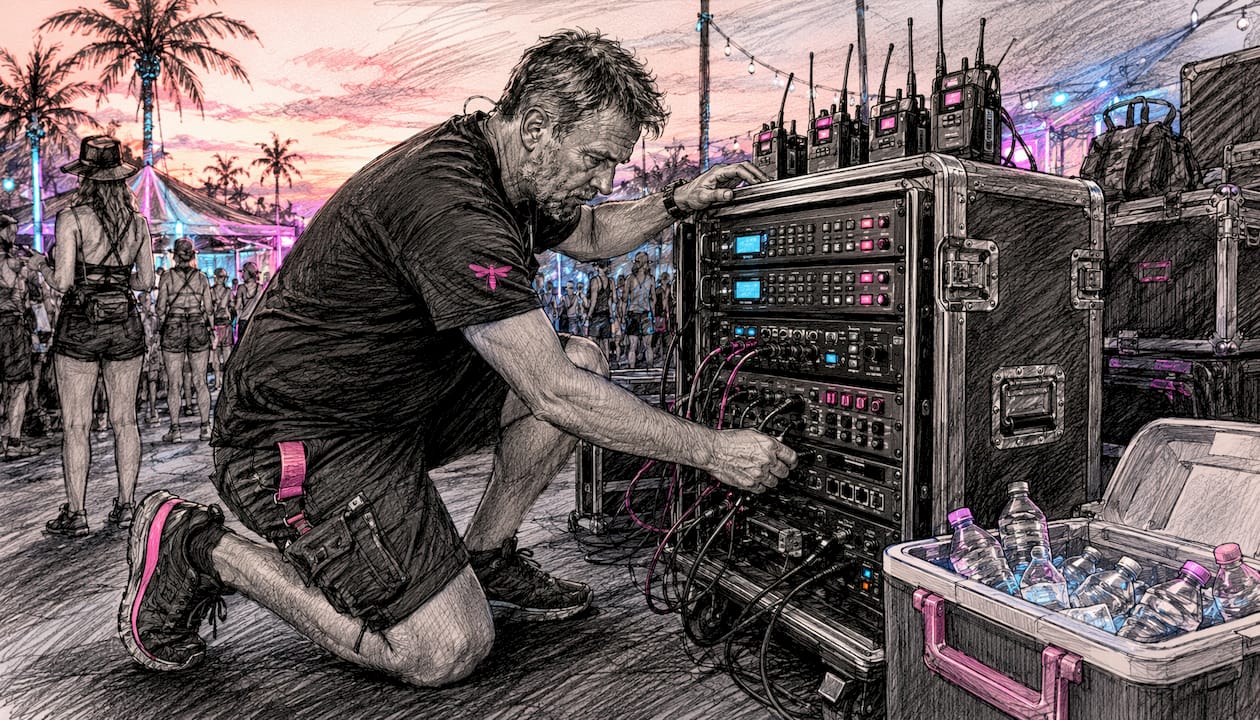
Redundancy is not a contingency luxury for live and hybrid events — it is the difference between a failure that stays invisible and one that plays out in front of your audience, your client, and your reputation. The three priorities to address before any event day are audio continuity, power stability, and network or encoder failover. Get those three right and you have covered the majority of the failure modes that end events early or embarrass clients.
Immediate first steps:
- Identify every single point of failure in your signal chain from source to output
- Assign a named backup operator for each critical function, not just a spare piece of kit
- Confirm that your backup network path uses a different provider from your primary
Table of Contents
- What redundancy actually covers for live events
- How much redundancy does your event actually need?
- What to duplicate first: a practical checklist for AV systems
- Runbooks, roles and escalation: how operational redundancy saves events
- How to test redundancy before the event
- Specifying and buying redundancy cost-effectively in the UK
- How Fireflyav approached layered redundancy at a UK hybrid conference
- Key takeaways
- The case for building redundancy in from day one
- Fireflyav can build redundancy into your next UK event
- Useful sources and further reading
What redundancy actually covers for live events
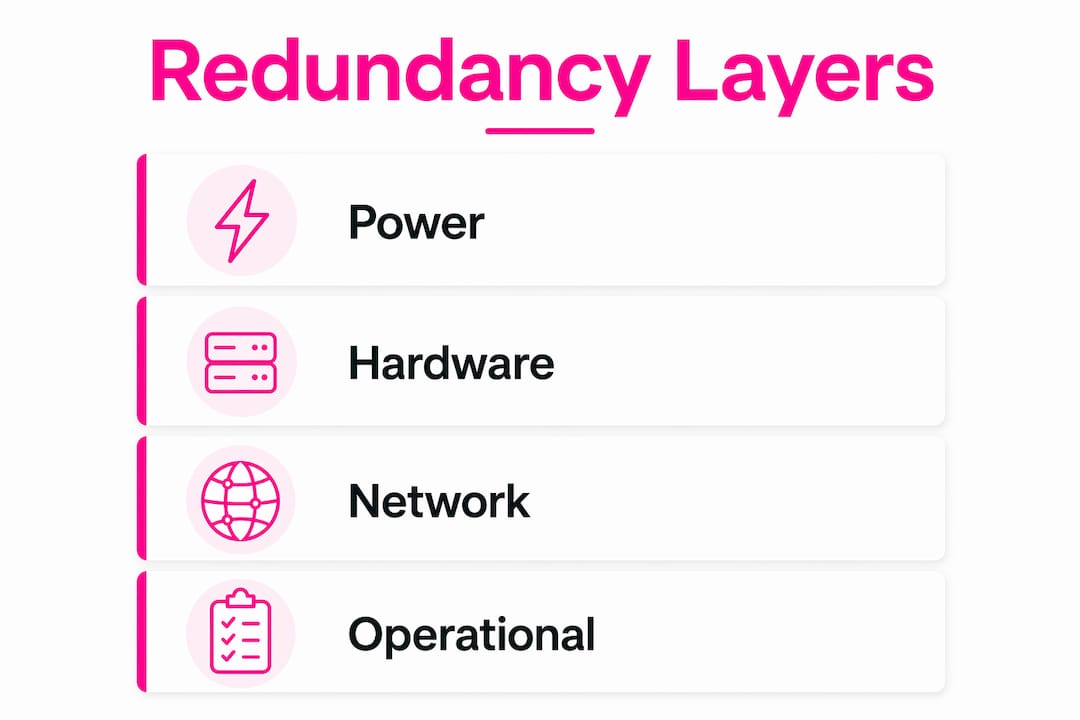
Redundancy spans four practical domains, and they stack in a logical order: power feeds hardware, hardware carries the network, and operations governs all three. Lose power and everything above it fails simultaneously.
Hardware redundancy means duplicate or spare devices: a second mixer, a backup encoder, spare wireless mic packs. Power redundancy means N+1 generator configurations with automatic transfer switches (ATS) so a generator fault does not kill the stage. Network redundancy means combining fibre, 4G/5G and sometimes satellite so a single provider outage does not drop your stream or your point-of-sale systems. Operational redundancy means trained backup operators, documented runbooks and rehearsed handovers.
Diversity matters as much as duplication. Two encoders on the same network switch, or two generators on the same fuel supply, share a single point of failure. Production companies design live workflows around the assumption that failure will happen, and they use diversity across routes and providers to prevent correlated failures that simple duplication cannot stop.
Pro Tip: Never rack your primary and backup encoders in the same physical rack on the same circuit. A tripped breaker or a rack fault takes both out simultaneously.
How much redundancy does your event actually need?
Not every event justifies a full hot-standby configuration. The right level depends on audience size, revenue exposure, broadcast obligations, and how long a visible outage is tolerable.
| Event type | Tolerable downtime | Recommended standby | Rationale |
|---|---|---|---|
| Internal board meeting | 5–10 minutes | Cold standby | Low audience, no broadcast, brief delay acceptable |
| Corporate conference (300 delegates) | Under 2 minutes | Warm standby | Reputational risk, sponsor visibility |
| Hybrid summit with live stream | Under 30 seconds | Hot standby | Remote audience drops permanently if stream fails |
| Public festival or broadcast event | Near-zero | Hot standby + diversity | Revenue, safety, broadcast SLAs |
Standby levels vary: hot standby runs in parallel for near-instant failover; warm standby is on-site and powered but not actively streaming; cold standby is on-site but unpowered, with longer recovery times. A hybrid summit where remote delegates outnumber those in the room has no tolerance for a cold-standby recovery with longer delay — by the time you are back online, the virtual audience has left.
What to duplicate first: a practical checklist for AV systems
Prioritise by failure impact, not by equipment cost.
| Item | Failure impact | Redundancy option |
|---|---|---|
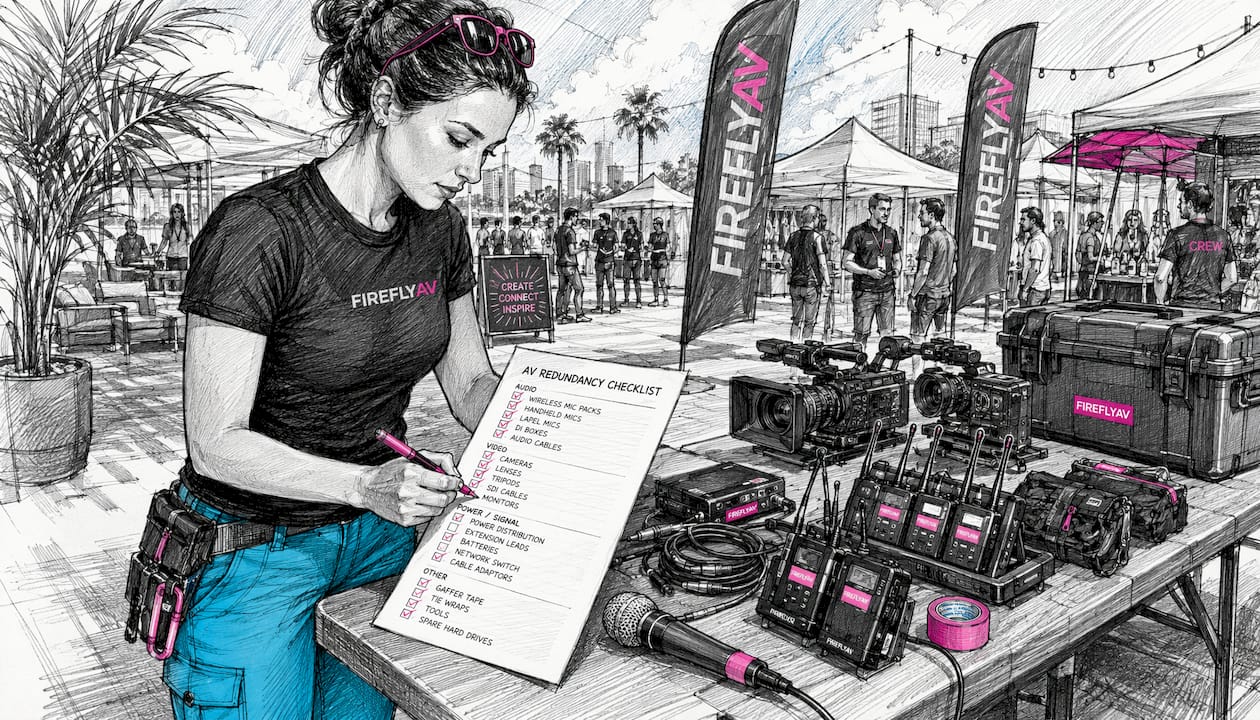
| Wireless microphones | Presenter goes silent mid-session | Dual mics on stage; spare battery packs pre-charged |
| Audio mixer / desk | Total loss of programme audio | Backup digital mixer pre-patched and gain-matched |
| Encoder / streaming device | Live stream drops for all remote viewers | Second encoder with independent ingest URL pre-configured |
| Primary network uplink | Stream and comms fail together | Secondary uplink via different ISP or 4G/5G bonded router |
| Power feed to critical racks | Everything in the rack goes dark | Separate circuit or UPS with generator ATS |
| Stage comms (IEM/intercom) | Crew loses coordination | Backup intercom channel; spare beltpacks charged |
A backup encoder without a backup network is incomplete, and a secondary uplink is useless if only one encoder can use it. Plan device and network failover together.
Pro Tip: Pre-configure your backup encoder with matching ingest keys and stream settings as the primary. A failover under pressure is not the moment to be typing credentials.
- Confirm spare mic packs are charged and tested before show time
- Keep a second set of XLR cables pre-run to the stage before doors open
- Label backup equipment clearly so any operator can identify and switch to it without asking
For a deeper look at the hardware involved, AV equipment for event planners covers specifications and compatibility in plain language.
Runbooks, roles and escalation: how operational redundancy saves events
Spare kit sitting in a flight case does nothing if no one knows when to switch to it or how. Operational redundancy — clear runbooks, named backup operators and rehearsed handovers — is as critical as the hardware itself.
A one-page runbook for each critical function should follow a simple structure: Symptom → Action → Owner. For example: “Stream drops for more than 15 seconds → switch ingest to backup encoder URL → Streaming Operator (backup: AV Technician 2)”. Operational cutovers scripted into micro-steps with exact credentials and verification checks remove the ambiguity that causes slow recovery under pressure.
Role assignment example:
| Function | Primary owner | Backup owner |
|---|---|---|
| Front-of-house audio | Lead Sound Engineer | AV Technician 1 |
| Live stream / encoding | Streaming Operator | AV Technician 2 |
| Network and connectivity | IT/Network Engineer | Streaming Operator |
| Stage manager | Stage Manager | Production Coordinator |
Escalation authority matters too. Define in writing who may trigger a failover — without that clarity, operators hesitate while the clock runs. Training multiple team members to fill essential positions reduces bottlenecks and keeps communication flowing during incidents.
Pro Tip: Print the runbook and tape it to the relevant operator’s position. A digital copy on a laptop that has just lost power is not useful.
An untrained backup is not a safety net — it is a second point of failure. Redundancy only works when the person picking up the role has rehearsed it, not just read about it.
How to test redundancy before the event
Lab checks are not enough. Dress rehearsals must mimic event bitrate, graphics load and authentication flows to surface the failures that only appear under real conditions.
- Encoder failover test — kill the primary encoder mid-stream and confirm the backup takes over within your acceptance threshold (typically under 30 seconds for a hybrid event).
- Primary uplink loss test — disconnect the primary ISP connection and verify the bonded router or secondary SIM takes over without manual intervention.
- Mixer fault simulation — mute the primary desk and confirm the backup mixer is gain-matched and ready to take programme audio.
- Power interruption test — simulate a mains failure and confirm the UPS or generator ATS transfers without a visible stage blackout.
- Authentication and playback check — after each failover, confirm the stream re-authenticates and remote viewers see continuous playback.
Record every test result. Testing must be recorded and versioned so you can demonstrate continuous improvement and identify recurring weak points.
| Test scenario | Acceptance threshold | Outcome | Time to recover | Sign-off |
|---|---|---|---|---|
| Encoder failover | Under 30 seconds | Pass / Fail | ___ seconds | ___ |
| Uplink loss | Under 30 seconds | Pass / Fail | ___ seconds | ___ |
| Mixer fault | Under 10 seconds | Pass / Fail | ___ seconds | ___ |
| Power interruption | Under 5 seconds (UPS) | Pass / Fail | ___ seconds | ___ |
Specifying and buying redundancy cost-effectively in the UK
Redundancy has a cost, but so does failure. The procurement conversation is about matching standby level to acceptable risk, not eliminating all risk at any price.
Procurement checklist when briefing suppliers:
- Specify named technical staff, not just headcount — “one AV technician” is not the same as “a trained streaming operator with failover experience”
- Include a contractual acceptance test: the supplier must demonstrate failover before the event goes live
- Request equipment diversity in writing: primary and backup devices from different manufacturers where possible
- Confirm SLA clauses cover the full event window, including load-in and breakdown
- For power, specify N+1 generator configurations with ATS; critical stages are typically fed by at least two generator sets for near-instant transfer
For multi-site events, AV logistics across venues adds complexity to every redundancy decision — transport contingency and spare kit distribution need their own plan.
Pro Tip: Ask suppliers to show you their runbook, not just describe it. A supplier who cannot produce a written failover procedure has not operationalised their redundancy.
How Fireflyav approached layered redundancy at a UK hybrid conference
A UK-based corporate client engaged Fireflyav to deliver a hybrid conference with approximately 300 in-room delegates and a simultaneous live stream to a remote audience. The brief required uninterrupted audio and video for both audiences across a full-day programme.
Fireflyav’s technical delivery included dual Blackmagic encoders configured with independent ingest URLs, a bonded 4G/5G router running alongside a dedicated venue fibre connection, a UPS protecting the streaming rack, and a named backup streaming operator briefed on the runbook. A pre-show failover drill confirmed both encoder paths and both uplinks before doors opened.
The stream remained uninterrupted throughout the day. A brief venue fibre instability mid-afternoon triggered an automatic switch to the bonded cellular path — the remote audience saw no interruption, and the in-room programme continued without pause.
Three lessons from that event apply directly to your planning: first, the failover drill caught a misconfigured ingest URL on the backup encoder that would have caused a 10-minute outage; second, having a named backup streaming operator meant the primary operator could focus on quality rather than contingency; third, the bonded cellular router paid for itself the moment the fibre dipped.
Key takeaways
Redundancy for live events works only when hardware, power, network, and operational layers are all covered and tested before the event goes live.
| Point | Details |
|---|---|
| Prioritise audio, power, and network | These three domains cause the most visible failures; address them before any other redundancy. |
| Match standby level to risk | Hot standby for hybrid streams; warm for corporate conferences; cold only for internal meetings with low stakes. |
| Operational redundancy is non-optional | Named backup operators and written runbooks prevent hesitation during high-pressure failovers. |
| Test under realistic load | Dress rehearsals must replicate event bitrate and authentication flows, not just bench conditions. |
| Fireflyav delivers layered redundancy | Fireflyav provides dual encoders, multi-uplink networking, UPS protection, and trained backup operators for UK events. |
The case for building redundancy in from day one
Most event failures are not dramatic. They are a wireless mic that drops in the middle of a keynote, a stream that freezes for 90 seconds while a remote audience refreshes their browser, a generator that trips and takes the stage lighting with it. None of these are unforeseeable — they are the predictable consequences of treating redundancy as an afterthought.
The events that run without visible incident are not lucky. They are the ones where someone, at the planning stage, asked “what happens if this fails?” for every critical system and then built the answer into the schedule, the budget, and the briefing documents. That discipline is what separates a production that looks effortless from one that becomes a post-mortem.
Fireflyav can build redundancy into your next UK event
When a live stream failure or a silent microphone is not an option, Fireflyav delivers the layered technical cover that keeps your event running. From dual-encoder streaming setups and bonded multi-uplink networking to N+1 power distribution and fully briefed backup operators, Fireflyav handles the redundancy planning so you do not have to.
Every engagement includes a pre-show failover acceptance test, written runbooks for each critical function, and named technical staff across the full event window. Fireflyav works with event managers and corporate clients across the UK, from single-room conferences to multi-stage hybrid productions. To discuss your event’s redundancy requirements and get a scoping call booked, fill in the project form and a member of the team will be in touch.
Useful sources and further reading
- AV equipment explained for event planners — hardware specifications and compatibility guidance for scoping redundancy requirements
- Event power distribution: the 2026 UK organiser’s guide — N+1 generator configurations, ATS, and safe power distribution for live events
- Broadcast AV equipment types: the 2026 professional guide — encoder and processing equipment reference for hot and warm standby decisions
- How production companies ensure redundancy and reliability — NetInsight’s technical overview of cross-layer redundancy design
- How to design a live streaming failover plan — practical guidance on standby levels, failover thresholds and acceptance testing
- Crisis-proofing your event tech — power, network and operational backup strategies for large-scale events
- Data backup best practices — recovery triage principles applicable to AV asset and configuration backup strategies